

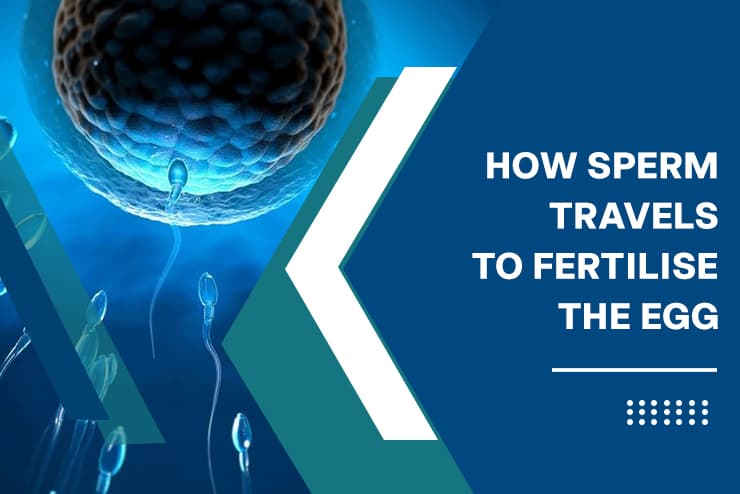
How Sperm Travels to Fertilise the Egg
How Sperm Travels to Fertilise the Egg
Of all the journeys in nature, few are as statistically improbable, biologically demanding, or scientifically fascinating as the journey of sperm to egg. In a typical ejaculation, somewhere between 200 and 500 million sperm are released. Of these, only a few hundred will ever come close to the egg. And of those, only one will achieve fertilisation. Every step of the journey filters, tests, and ultimately selects the sperm most capable of successfully contributing to a new life. Understanding how this journey unfolds — and why it is designed to be so demanding — reveals a great deal about reproductive health, fertility challenges, and the science behind assisted conception.
The Starting Line: Ejaculation and the Vaginal Environment
The moment sperm are ejaculated, they enter an environment that is, by default, hostile to them. The vaginal canal maintains an acidic pH of around 3.5 to 4.5 — a necessary defence against bacterial infection, but immediately lethal to most sperm. Sperm are sensitive to acidic conditions, and those that cannot clear this zone quickly are immobilised and die within minutes.
Their primary initial protection comes from the seminal plasma — the fluid in which sperm are suspended. Seminal plasma is alkaline, containing compounds such as citrate, zinc, and fructose that temporarily buffer the vaginal acidity and provide sperm with the energy they need for motility. This alkaline protection is transient, however, lasting only long enough for the most motile sperm to advance toward the cervix. This early phase of the journey is essentially a race, and only the fastest movers survive it.
The Cervix: A Selective Gateway
The cervix represents the first major anatomical barrier and, crucially, the first major selection checkpoint. Cervical mucus — produced by glands within the cervical canal — is not a uniform fluid. It is a complex, dynamic hydrogel whose properties change throughout the menstrual cycle under the influence of hormones.
During most of the cycle, under the influence of progesterone, cervical mucus is thick, dense, and impenetrable — a defensive barrier that prevents pathogens (and sperm) from entering the uterus. At ovulation, under the surge of oestrogen, the mucus undergoes a dramatic transformation. It becomes thinner, more fluid, and organises itself into microscopic channels that specifically allow progressively motile sperm to pass through. This is the biological window during which natural conception is possible.
The cervical mucus is not merely a passive gatekeeper. It actively selects. Sperm with poor motility, abnormal morphology, or non-progressive swimming patterns are filtered out. Those with forward-directed, progressive motility navigate the channels and pass through into the uterine cavity. In this sense, the cervix functions as a quality control checkpoint — eliminating a large proportion of sperm before they advance any further.
Even at this stage, the numbers drop dramatically. Hundreds of millions of sperm may enter the vaginal canal, but only one to five percent — millions, rather than hundreds of millions — successfully penetrate the cervical mucus.
Through the Uterus: Contractions, Currents, and Chemotaxis
Once inside the uterine cavity, sperm face a new set of challenges. The uterus is not a simple open space — it is a muscular organ whose walls contract rhythmically, particularly around the time of ovulation. These contractions, driven by prostaglandins present in seminal plasma, are not random. Research suggests they generate fluid currents that help propel sperm upward toward the fallopian tubes.
The uterine lining also plays an active guiding role. The endometrium secretes a range of chemokines and cytokines — small signalling proteins — that create chemical gradients within the uterine fluid. Sperm can detect these gradients and respond to them through a process called chemotaxis: directional movement toward higher concentrations of specific chemical attractants.
Thermotaxis — movement guided by subtle temperature differences — is another navigational mechanism. The body of the uterus is approximately 34°C, while the area near the ovulating follicle in the fallopian tube is marginally warmer. Sperm are able to detect this small temperature gradient and orient themselves toward warmth, providing an additional directional cue in an otherwise featureless fluid environment.
The uterus also presents an immunological challenge. Sperm are genetically foreign to the female body — they carry paternal DNA that is antigenically distinct from the mother's own tissues. The immune system has mechanisms to tolerate sperm during the fertile window, including regulatory T cells that are thought to be primed by exposure to seminal plasma. However, immune-mediated sperm destruction still occurs in the uterine cavity, reducing numbers further.
The Uterotubal Junction: Another Bottleneck
At the point where the uterus meets each fallopian tube — the uterotubal junction — sperm face another critical passage. This junction is narrow and physiologically regulated. It does not permit unrestricted access, and sperm that lack the motility or biochemical credentials to pass through are left behind.
The number of sperm that successfully enter a fallopian tube is dramatically smaller than the number that entered the uterus. Estimates suggest that only a few thousand sperm, at most, make it into the tubes — and they must enter the correct tube (the one containing the egg, since ovulation typically occurs on only one side each cycle). Those that enter the wrong tube face a dead end.
The Fallopian Tube: Capacitation and the Final Sprint
Inside the fallopian tube, the surviving sperm undergo one of the most important biological transformations of their journey — a process called capacitation. Capacitation is a series of biochemical changes to the sperm cell that are required for it to be capable of fertilisation. It does not happen immediately or all at once; it unfolds gradually over one to ten hours.
During capacitation, the composition of the sperm cell membrane changes significantly as cholesterol is removed, altering its fluidity and the function of embedded proteins. Ion channels in the membrane become more active, causing an influx of calcium ions into the cell. This calcium surge is a key trigger for the subsequent changes in sperm behaviour and function.
One consequence of capacitation is the activation of hyperactivated motility. Whereas sperm swimming in the uterus and lower fallopian tube use a relatively symmetrical, forward-propulsive beat of their tails, hyperactivated sperm adopt a dramatically different pattern — a vigorous, asymmetric, whip-like movement that produces much greater propulsive force. This powerful motion is necessary to penetrate the cumulus oophorus (the layer of cells surrounding the egg) and the zona pellucida (the egg's outer shell).
The fallopian tube epithelium also serves as a temporary reservoir for sperm. Cells in the lower portion of the tube (the isthmus) have been shown to bind sperm and hold them in a quiescent, stored state. This reservoir serves two purposes: it extends the window of time during which sperm remain viable and capable of fertilisation, and it synchronises sperm release with ovulation, ensuring that capacitated, hyperactivated sperm are available when the egg arrives.
Meeting the Egg: Zona Binding and the Acrosome Reaction
When a capacitated sperm finally reaches the egg — surrounded by its cumulus cells and zona pellucida — it must still overcome the egg's outer defences to achieve fertilisation.
The cumulus oophorus is a cloud of cells embedded in a hyaluronic acid matrix that envelops the egg. Sperm must physically penetrate this layer using their hyperactivated motility and enzymatic activity, including the enzyme hyaluronidase, which digests the hyaluronic acid matrix.
Once through the cumulus, the sperm contacts the zona pellucida — a thick, translucent shell made of glycoproteins (primarily ZP1, ZP2, and ZP3). Proteins on the sperm surface bind specifically to ZP3 receptors on the zona in a highly species-specific recognition event. This binding triggers the acrosome reaction — the controlled release of hydrolytic enzymes stored in a cap-like vesicle at the tip of the sperm head called the acrosome. These enzymes, including acrosin and proteases, locally digest the zona pellucida, creating a pathway for the sperm to tunnel through.
Only one sperm is permitted to fertilise the egg. The moment a single sperm fuses with the egg's plasma membrane, the egg undergoes two rapid responses to prevent polyspermy (fertilisation by multiple sperm). The first is an electrical fast block — a rapid change in the electrical charge across the egg's membrane that instantly prevents other sperm from fusing. This is followed within minutes by the cortical reaction, in which enzymes released from the egg's surface harden and chemically modify the zona pellucida, creating a permanent mechanical barrier against additional sperm.
Fertilisation: The Moment of Union
When sperm and egg membranes fuse, the sperm nucleus — carrying 23 paternal chromosomes — enters the egg. The egg, which had been arrested at a specific stage of meiosis, now completes its final division, expelling the second polar body and reducing its chromosome count to 23. The two sets of chromosomes — paternal and maternal — come together to form the diploid nucleus of the zygote: a cell with the complete 46-chromosome human genome.
Within 24 to 30 hours, this zygote undergoes its first cell division, and one of the most extraordinary journeys in biology — both the journey of the sperm and the journey of an entire human development — begins in earnest.
Conclusion
The journey of sperm to egg is one of nature's most elegant filtration systems. Its extraordinary difficulty is not a flaw in the design — it is the design. By subjecting hundreds of millions of sperm to progressively demanding obstacles, the female reproductive system selects not just for motility and morphology, but for capacitation competence, zona-binding ability, DNA integrity, and biochemical readiness for fertilisation. In IVF, where sperm are selected in the laboratory and placed directly alongside the egg, understanding this journey helps clinicians appreciate what natural selection was achieving and to apply those principles — however imperfectly — to improve outcomes for patients.
Content Created By:

SEART Editorial Team
Faculty Of Embryologists at SEART